


Nothing screams diesel power like the bark of a Brake Jake. But the company behind this engine braking technology is rapidly evolving to ensure it remains relevant for many years to come — developing valve technologies that will reduce emissions and reduce fuel consumption.
Engine maker Cummins is convinced that Jacobs can play a role in the next generation of cleaner-burning engines, to the extent that it bought the company in February and has already begun investing heavily in the Jacobs plant in Bloomfield, Conn., where it is doubling the production capabilities.
Jacobs, meanwhile, built a demo truck to showcase its latest valve technologies, cylinder deactivation (CDA) and active decompression technology (ADT). It’s also a smart thing to do, as the magic happens far out of sight, deep inside the engine, and the ultimate goal is to make the experience seamless for the driver.
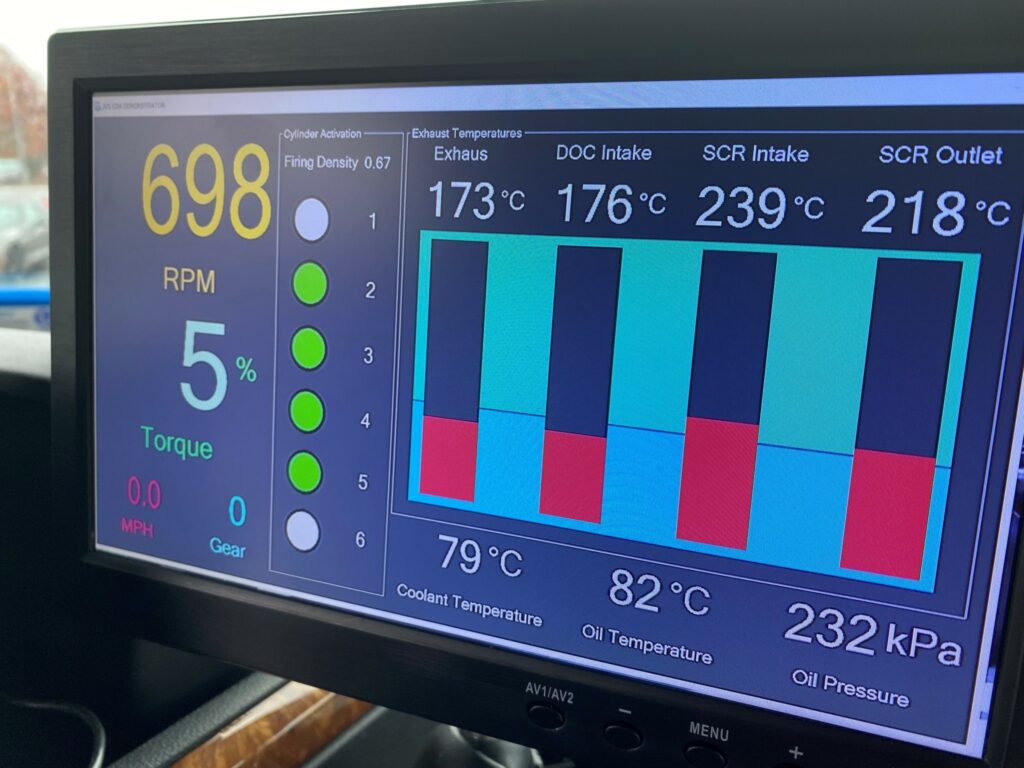
The test truck includes switches that can turn the CDA and ADT systems on or off, so drivers can experience both systems on and off under identical operating conditions in the same vehicle. An in-cab display, installed solely for demonstration purposes, shows the technologies working as intended, providing the results obtained from extensive laboratory testing and the early stages of field validation work.
Jacobs’ CDA and ADT are designed to work with any make of engine, but the demo truck is an International LT625 tractor with an A26 diesel engine.
“We will be working with a wide variety of major commercial vehicle stakeholders over the coming months to schedule test drives to showcase and showcase our latest technologies,” said Steve Ernest, Jacobs vice president – engineering and business development. Trucking trade press editors were among the first to experience the technologies during a Nov. 1 demonstration at a track near Jacobs’ Connecticut headquarters.
Roll off
With the next round of federal EPA emissions standards in the final stages of development and set for Model Year 2027 implementation, cylinder deactivation is considered a key factor for engine OEMs to meet stricter NOx standards.
CDA converts a six-cylinder diesel engine into one that uses only four or fewer cylinders under the right operating conditions to reduce fuel consumption, but also to better maintain the optimal operating temperatures required for the operation of the exhaust gas aftertreatment under low load and starting conditions . Of course, burning less fuel also results in reduced CO2 production, so CDA takes a two-pronged approach to emissions reduction and compliance.
This solves an age-old problem. Increasing the aftertreatment temperature to eliminate NOx has traditionally meant increased fuel consumption and higher CO2 efficiency.
When the diesel engine load falls below a predetermined threshold, selected cylinders are deactivated, improving fuel economy by up to 25% in certain conditions. This also prevents cold air from entering the cylinders, improving selective catalytic reduction (SCR) performance with a 77% NOx reduction rate and 12% CO2 emissions reduction. While the technology has been used for years in the passenger car market, it needs to be completely reinvented for commercial vehicle applications, officials explained.
Jacobs has tested it on 20 different heavy-duty engine platforms around the world, accumulating more than 27,000 hours and 200,000 miles of endurance testing. Most notably, it was demonstrated in the US Department of Energy’s Super Truck II program with Navistar.
“As an ‘in-engine’ technology, CDA may add a small cost to engine production, but this cost can be mitigated by reducing the size and complexity of the aftertreatment system or eliminating the need for other emission-reducing technologies.” , Ernest explained. . “Because CDA ultimately reduces fuel consumption and requires less maintenance than other external solutions designed to increase aftertreatment temperatures, it will result in a lower total cost of ownership.”
One of the challenges is to disable the cylinders without introducing harshness or vibrations that are noticeable from the driver’s seat. There’s no way to match the smoothness of the six-cylinder operation – how the engine was designed to operate – but I didn’t notice any additional vibration when driving with the cylinders disabled.
If it wasn’t for the display mounted in the cockpit for demonstration purposes, I wouldn’t have known anything had changed in the engine. As for the CDA’s ability to better maintain high in-cylinder operating temperatures for more efficient SCR operation, this would also be invisible without the same display.
In low load situations (we were bobtailing), with cylinder deactivation disabled, there was a sudden drop in exhaust, DOC inlet, SCR inlet and SCR outlet temperatures, requiring the SCR system to work harder. With CDA on and cold air not entering the cylinders, higher exhaust gas temperatures were maintained for longer to improve SCR performance.
How effective is it? Independent tests showed that at low load cycles, CDA reduced NOx emissions by 86%, while CO2 and fuel consumption were reduced by 12%. The test truck, in local city no-load testing, showed CDA active 49% of the time, with engine warm-up taking half the normal time and average SCR output temperatures increasing by 21.5C. On the highway, towing a trailer, the CDA was active 22% of the time.
The greatest benefits will be seen in applications involving frequent starting and stopping, high idle, load shedding or empty return trips.
“No one runs full loads every time they run on the road,” pointed out Robb Janak, director of new technology for Jacobs. “We are not claiming that CDA will save much fuel in high load conditions.”
For maximum results, CDA requires loads of less than 30%. “I want to see what the fleet can really get and that’s why we created this demonstrator vehicle to get into the fleets,” added Janak.
Active decompression technology
ADT saves fuel in a completely different way, removing the harshness of engine starts and stops and making auto start/stop in passenger cars more enjoyable for commercial vehicle drivers. It’s widely expected that start/stop systems will be required to meet looming emissions standards, but the idea is mind-boggling to commercial truck drivers who are used to the harsh “death knell” that comes every time a diesel engine shuts down.
Fleet operators are also wary of the technology’s impact on the starter motor, ring gear and battery wear.
This cabin shake is significantly reduced using ADT, which can be integrated into multiple engine platforms. Jacobs says engine shake is reduced by 90% using ADT, and it would be hard to dispute given first-hand experience with the system on and off in the demo truck. An attractive side benefit is that drivers will be able to sleep better without hard starts and engine shutdowns when using automated start/stop to maintain battery charge while idling during rest periods.
ADT keeps the engine’s valves open and cylinders decompressed so it shuts down smoothly. During starting, the engine is held in a decompression mode which reduces crank torque by 40% and allows the engine to spin up to twice its normal speed for a smoother start. Wear on the starter mechanism, flywheel and other components is reduced, allowing the use of smaller and lighter batteries, cables and starters, Jacobs says.
It also benefits cold weather starts by allowing the engine to roll over while decompressed, allowing the engine to reach critical compression ignition speeds. When combined with supplemental air intake heaters, ADT preheats cylinders without engine load from compression which reduces battery charge levels.
“This originally started as a project we were asked to do to stop the driver waking up when the engine was running at night to charge the hotel’s batteries,” Janak said. “Closing would shake the driver out of bed. We solved it with this mechanism and received more requests: will it help to start? We continued to evolve it to improve starting and stopping, get rid of shake and also reduce wear.”
The hope is that the technology will enable the use of automatic start/stop systems to reduce fuel consumption and emissions without aggravating the driver with the harsh jolts normally associated with these starts and stops.
Both of these technologies, along the development path, will be marketed to OEM engines in time for the 2027 emission standards. Jacobs manufactures its own valvetrains, which are then sent to the OE engine for integration and installation in own production lines.
Janak told TruckNews.com that engine OEMs are still waiting for the EPA to say exactly what emissions reductions will be required for the 2027 Model Year, but that CDA and ADT will be ready to help them meet those goals when needed. .


